
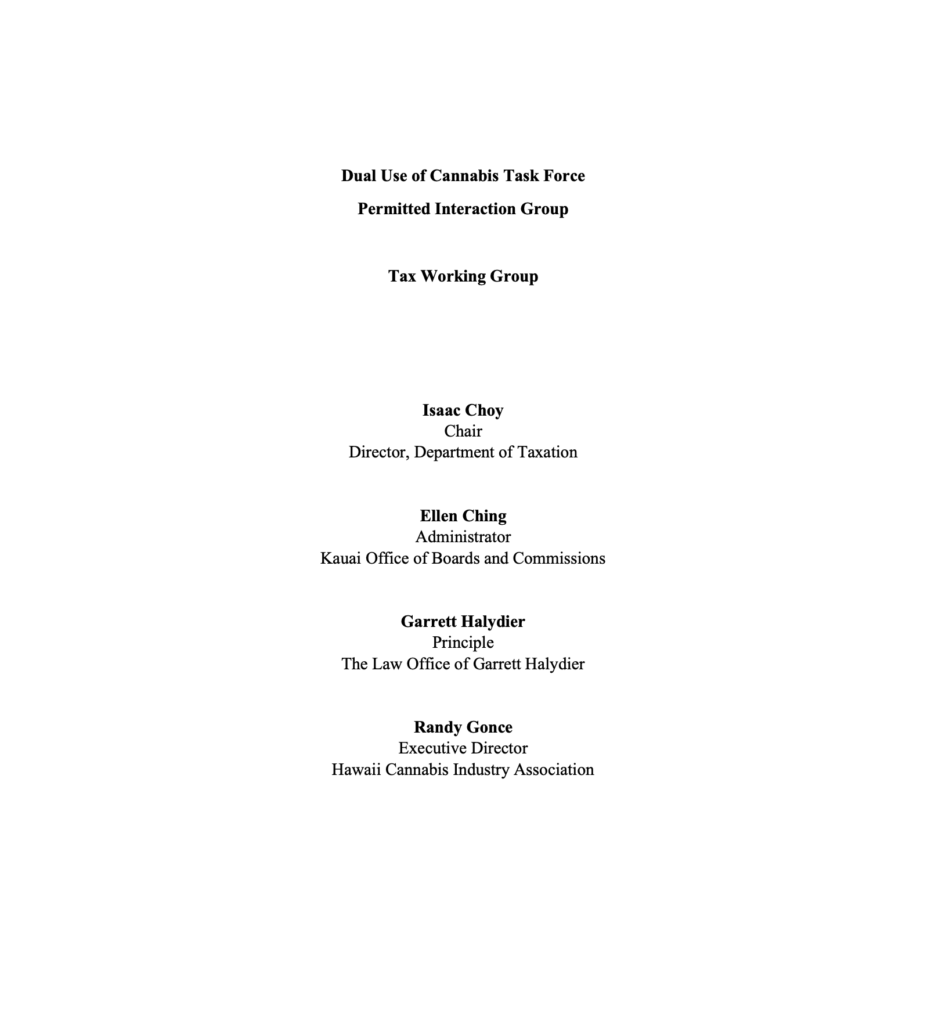
Dual Use of Cannabis Task Force
Permitted Interaction Group
Tax Working Group
Executive Summary
This report investigates potential tax regimes for a dual-use cannabis system in the State
of Hawaii and estimates tax revenues. Tax revenues are a function of market operations. As a
result, this report had to assess the current cannabis market in Hawaii, develop potential
scenarios for a dual-use market, and then model the operations of the market. The report
recognizes the great uncertainty in predicting the developments of a non-existent legal market.
There is nearly a decade of experience with adult-use cannabis that can provide important
lessons for Hawaii. Recreational states generally experience high prices in the initial phase of
market operations followed by a dramatic decline. Legal dispensaries in Hawaii are already
competing with a national gray market. Recreational states see higher levels of reported
consumption compared to non-recreational states. Most cannabis consumption derives from a
small population of heavy users. The Federal government has taken a hands-off approach to the
cannabis industry in states that promote well-regulated markets.
The Hawaii current cannabis market, estimated to be worth $240 million, operates in a
gray space. Certain sectors like the medical marijuana market are legal and highly regulated while
other parts remain illegal but are tolerated and subject to little or no regulation. It is estimated that
only 21% of cannabis purchases made in 2021 were made at a legal dispensary. This has created
a two-tiered market where the prices in the legal market are much higher than in the gray market.
This incentivizes users, even those with a medical card, to make their purchase in the illicit gray
market. Decriminalization and other decisions to not vigorously prosecute the illicit production and
sale of marijuana have reduced some of the punitive consequences of operating in the gray
market. Underutilization of the dispensary program indicates that most card holders purchase
marijuana in the gray market. The major reason for the preference for the gray market is price.
This report finds that issues related to market structure and regulation result in high prices
that are uncompetitive relative to the gray market. Laws and regulations that limit scale, market
size, competition, and specialization create an unfavorable market structure. The cannabis
industry already faces higher production costs relative to other industries due to classification of
cannabis as a Schedule I drug. This imposes higher Federal corporate taxes on the sector due to
the 280E clause and excludes cannabis firms from traditional banking services. The report
recommends that these issues be considered if the State decides to legalize recreational use.
This report estimates that the size of a mature cannabis market that includes legal and
illegal sales to be $354 million. Economic models developed for this report estimate that the
legal price of adult-use cannabis would have to be in the range of $225-$275 per ounce to
effectively compete with the gray market. This would imply legal sales worth $172-$273 million
and tax revenues of $34-$53 million. Tax revenues and legal market size would be even larger
if prices fell below this range. Prices often fall below $200 per ounce in states with mature
cannabis markets, so a price point below $200 is reasonable under a favorable regulatory
regime. A poorly regulated market would drive consumers to make purchases in the gray
market, driving down tax revenues, and keeping most transactions beyond regulatory reach.
The results of the cost-production model suggest that legal firms in Hawaii can effectively
compete with the gray market, particularly if the State elects to gradually phase-in the excise
tax. The analysis shows that the cost-of-production and mark-up significantly impact the final
price of cannabis. Regulation and market structure ought to promote conditions that favor a legal
price that can compete with the gray market.
The report concludes with a set of useful economic principles that will contribute to a
well-functioning market. These include using a system of carrots and sticks to incentivize
desirable market behavior, developing the capacity to be flexible, encouraging healthy
competition, allowing innovation, and applying the law in a uniform manner.
Recommendations from Tax Working Group
Recommendation I: The committee recommends that if Hawaii lawmakers decide to proceed
with adult-legalization, they should pursue a legal strategy that promotes a cannabis industry that
is not subject to burdensome levels of regulation and taxation. The legal and regulatory framework
should promote the development of a mature well-functioning market that can effectively compete
with the gray market.
Recommendation II: If the State elects to legalize recreational use, a cannabis excise tax should
be levied on the final sale of cannabis products. The cannabis excise tax would be in addition to
the GET of 4.5%. The excise tax would start out low in the initial phases of the market and increase
as the market matures to a rate of 15%. The proposed excise tax rate is 5.0% for the first two
years that the recreational market is operational, 10% for years three and four, and 15% in the
fifth year of operation and beyond. Excise tax revenues would be divided between the State,
which would receive 80% of revenues, and the counties, which would receive 20% of revenues.
The county portion of the excise tax would be allocated to the county where the sale is made.
This strategy would allow the legal market to compete with the gray market on price in the initial
phase of market development. The size of the excise tax would increase as the legal market
matures.
Recommendation III: This committee recommends parity in taxation between the medical and
cannabis market if and only if the following trigger has been met. The trigger is that the price of
cannabis has experienced a percent decline from the price in the medical market prior to
recreational legalization that is larger than the cannabis excise tax. If this trigger is not met,
medical marijuana patients will not be subject to the cannabis excise tax. This will ensure that
affordability for medical patients has increased while closing a potential tax loophole that would
allow heavy users to avoid the excise tax.
The following recommendations officially fall outside the purview of the tax working group.
However, the recommendations I-III are contingent on a well-functioning market that
outcompetes the illicit market, allows businesses to actively compete with one another to meet
consumer demand, mitigates public health risks, and promotes a culture of legality.
Recommendations IV and V are seen as important for the future health of Hawaii’s cannabis
industry.
Recommendation IV: This report assumes that the market will be segmented into producers,
manufacturers, retailers, and testing facilities. It recommends that limits on the number of licenses
issued to producers and manufactures be kept to minimum. This will encourage smaller players
currently operating in the gray market to start operating legally. It will minimize the price differential
between the legal market and the gray market. And it will promote competitiveness within the
industry. Enforcement efforts ought to be effective and deter people from operating in the gray
markets. The number of licensed retailers will depend on market demand, community
preferences, population density, and geography. The report recommends that the cannabis
regulator have some discretion over the number of licenses issued, allowing it to respond to
market developments.
Recommendation V: This report finds that a strong independent cannabis agency is most likely
to oversee the development and operation of a well-functioning cannabis market. An
independent agency is more likely to be able to successfully manage multiple considerations
like public-health and market development. Legislation ought to provide the legal framework for
the cannabis market while the agency ought to be given powers to develop, modify, and enforce
regulations that are more technical in nature. To increase accountability and transparency, it is
recommended that major decisions by the agency must be reviewed by an advisory board
whose members include: 2 members from the cannabis industry, 1 member from the
Department of Health, 1 member from the Department of Public Safety and 3 members
appointed by the Governor. At least one board member must represent an island that is not
Oahu.
https://health.hawaii.gov/medicalcannabis/files/2022/08/CANNABIS-TAX-PIG-REPORT-FINAL.pdf